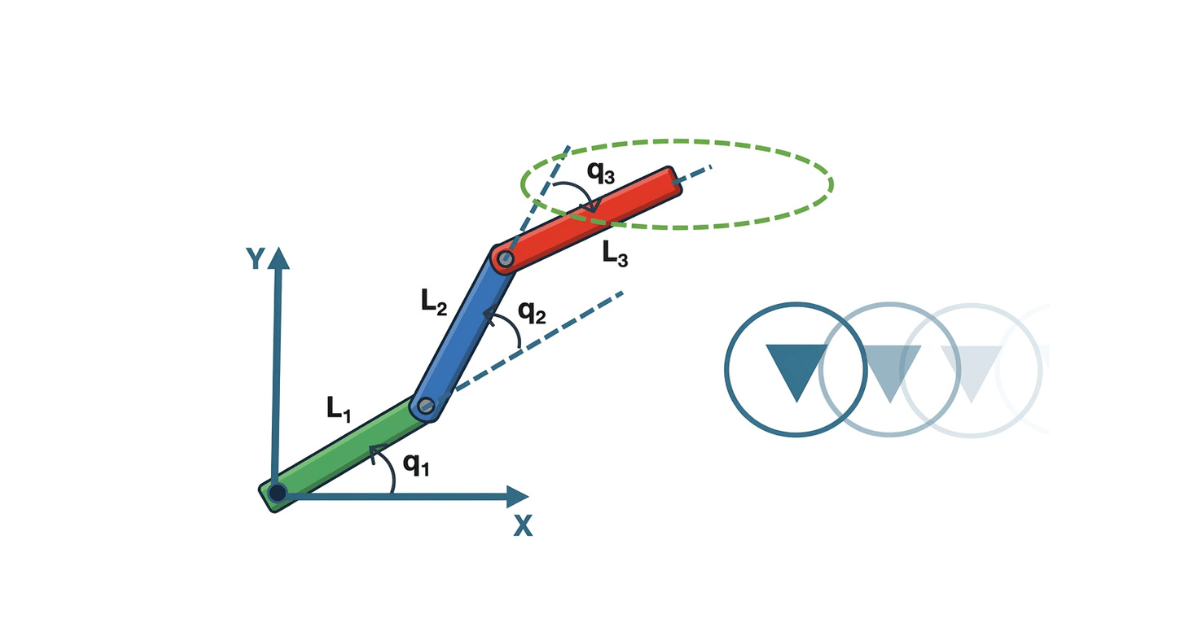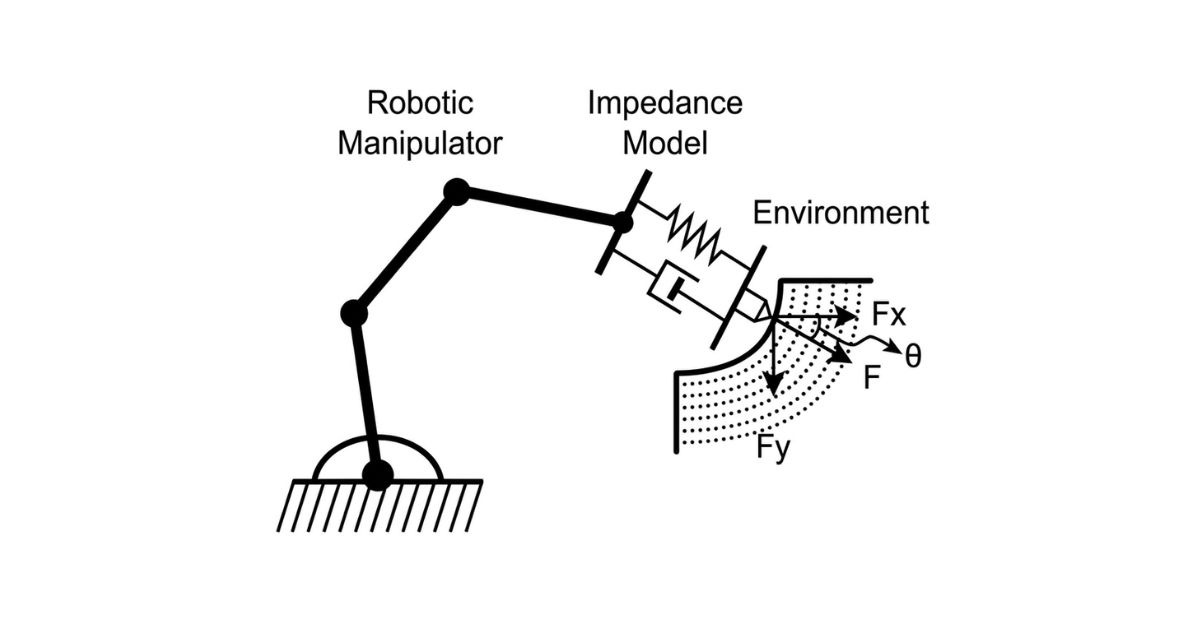
Robots operating in contact-rich environments, such as grinding, polishing, surface finishing, cleaning, and assembly, require advanced force control strategies to interact safely and accurately with their surroundings. Traditional motion control approaches are often insufficient for these applications, as variations in environmental properties can lead to force tracking errors, excessive contact forces, or damage to the robot and workpiece.
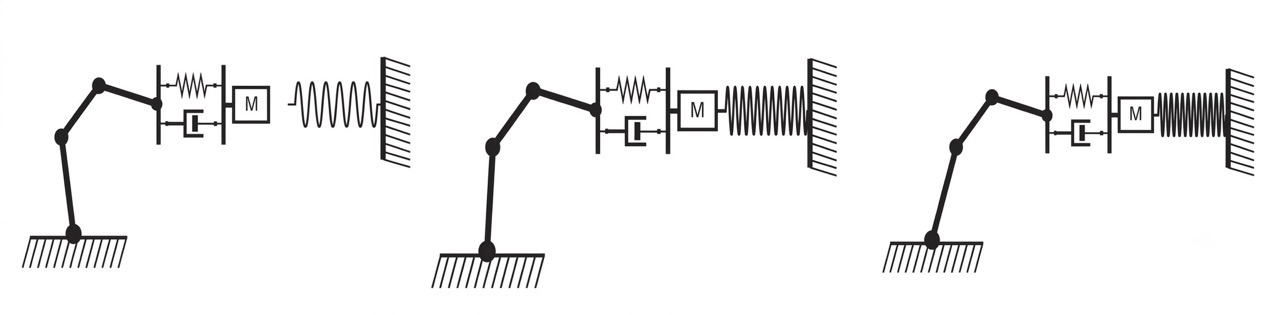
This project investigates an adaptive variable impedance control framework that enables a robot to dynamically regulate interaction forces under uncertain environmental conditions. Unlike conventional impedance controllers that rely on fixed stiffness and damping parameters, the proposed approach adapts the impedance parameters based on the interaction state, allowing the robot to maintain stable force tracking despite changes in surface properties.
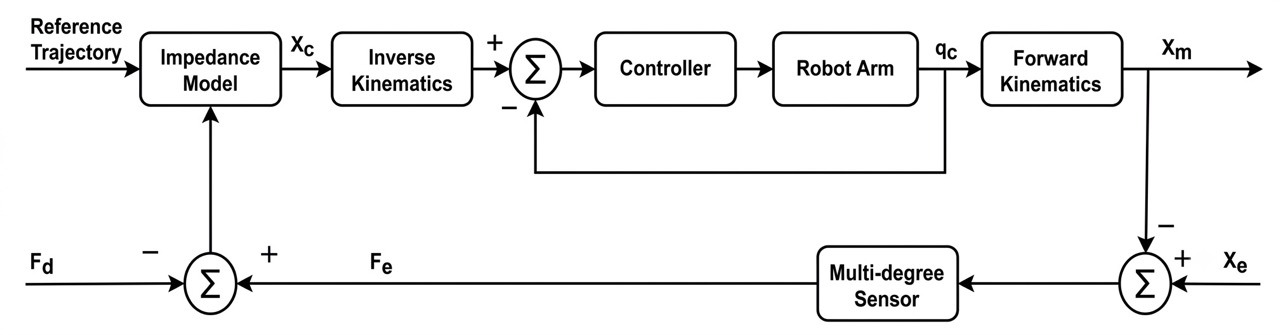
Block diagram of position-based impedance control for force tracking. The reference trajectory along with the net force computes the commanded position followed by inverse kinematics calculation. The PID controller is used to control the robot arm.
The controller models the robot–environment interaction using a virtual mass–spring–damper system and adjusts the desired motion response according to the external contact forces. This enables accurate force regulation without requiring complete knowledge of the environment dynamics.
Singularity Avoidance for Redundant Robots
For redundant robotic systems, additional degrees of freedom provide flexibility to avoid singular configurations and improve motion capability. This project integrates a singularity avoidance strategy into the inverse kinematics framework, allowing the robot to maintain high manipulability while executing complex contact trajectories.
The inverse kinematics solution is obtained using the Damped Least Squares method, combined with a manipulability-based optimisation strategy to prevent singular configurations during task execution.
Key Results
- Developed an adaptive variable impedance controller for force tracking under uncertain environmental conditions.
- Reduced force-error overshoot during environmental stiffness transitions by up to 56.13% compared with constant impedance control.
- Improved robot manipulability by 5.95% through an integrated singularity avoidance strategy.
- Demonstrated stable multi-axis force tracking for redundant robotic manipulators performing complex contact trajectories.
Citation
Muhammad Bilal, M. Nadeem Akram, Mohsin Rizwan. "Adaptive Variable Impedance Control for Multi-Axis Force Tracking in Uncertain Environment Stiffness with Redundancy Exploitation." Journal of Control Engineering and Applied Informatics, vol. 24, no. 2, pp. 35–45, 2022.