
Collaborative robots (or cobots) are widely used in research laboratories for a range of manipulation tasks. Most cobots, such as Swayer and Franka Emika 7-DoF robots, have more degrees of freedom (DoF) than are required to perform a given task. This redundancy means that the same end-effector pose can often be achieved using multiple, and in many cases infinitely many, joint configurations. In such cases, the robot could use its redundant DoF to satisfy additional objectives while still completing the main task. The primary objective is typically to achieve the desired end-effector motion or pose, while the remaining DoF could be exploited for secondary objectives such as avoiding singularities, maintaining a safe distance from obstacles, avoiding joint limits, or reducing unnecessary joint motions.
Redundancy resolution is therefore concerned with determining an appropriate joint configuration or motion from the available solutions while satisfying the primary task and optimizing one or more secondary objectives. In other words, it provides a way to exploit the robot’s additional DoF to select a solution that is not only task-feasible but also desirable according to desired criteria.
This simulation-based study investigates how redundancy resolution can be used to avoid singular configurations and dynamic obstacles while maintaining the primary objective of task completion. A singular configuration occurs when the robot loses one or more independent directions of end-effector motion, limiting its ability to move freely in certain directions.
Simulation Environment
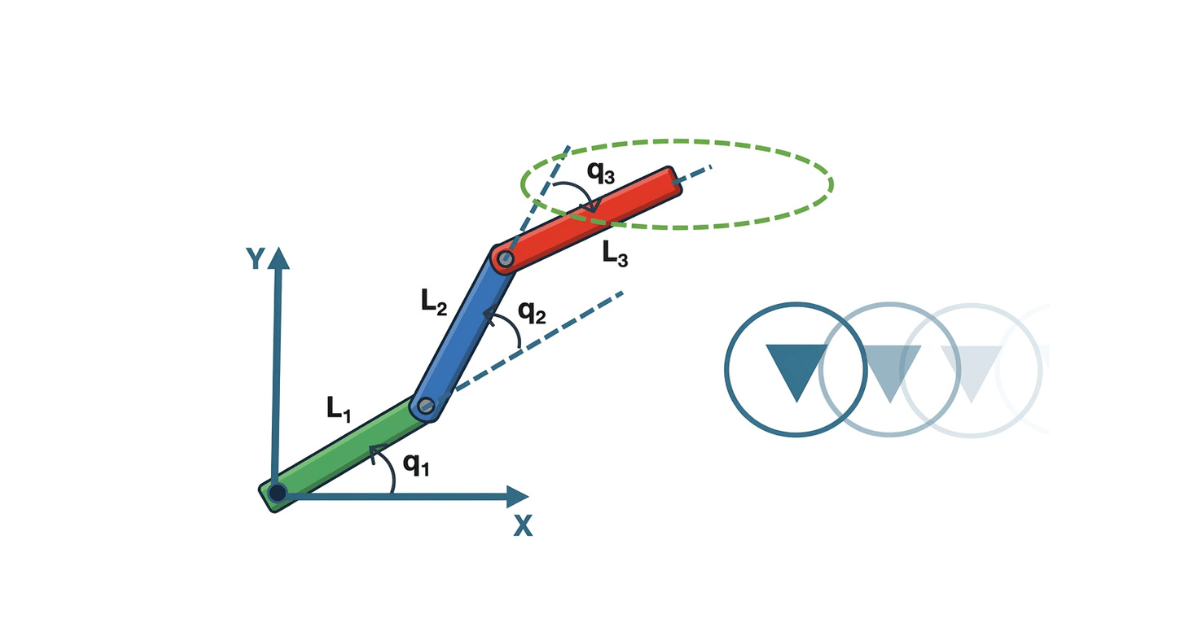
The algorithm is implemented on a 3R planar robot operating in a 2D workspace. The robot has three joint DoFs, while the end-effector position requires only two DoFs (x and y). Therefore, the robot has one redundant DoF, allowing multiple joint configurations to achieve the same end-effector position.
Singularity Avoidance
To evaluate singularity avoidance, the robot is commanded to follow a straight-line trajectory in the workspace. Two conditions are considered. In the first condition, the robot only optimizes the primary objective of following the desired trajectory. In the second condition, the robot follows the same trajectory while also optimising a secondary objective for singularity avoidance.
The difference between the two conditions can be visualised using the manipulability ellipsoid. The ellipsoid represents the robot’s ability to generate end-effector motion in different directions. A larger ellipsoid volume indicates higher overall manipulability and therefore greater distance from a singular configuration. In this experiment, the ellipsoid is larger when the singularity-avoidance objective is included, demonstrating how the redundant DoF can be used to improve the robot’s manipulability while maintaining the desired end-effector trajectory.
With Singularity Avoidance
The results are visualised using a manipulability ellipsoid. As the robot approaches a singular configuration, the ellipsoid area shrinks. A larger ellipsoid indicates higher manipulability, meaning the robot is far from a singularity. At a fully extended position, a hard singularity cannot be avoided, and the ellipsoid collapses into a straight line.
Dynamic Obstacle Avoidance
A dynamic obstacle avoidance algorithm is implemented to investigate how the redundant DoF can be used to avoid moving obstacles while maintaining the primary task. The robot is required to follow a predefined trajectory while a dynamic obstacle moves through its workspace.
Two objectives are considered: the primary objective of following the desired trajectory and the secondary objective of avoiding collisions with the moving obstacle. When the obstacle approaches the robot, the redundancy resolution algorithm adjusts the robot’s joint configuration to move the robot away from the obstacle while continuing to follow the desired end-effector trajectory.
With Obstacle Avoidance
The simulation demonstrates that the robot can adapt its joint configuration in real time to avoid the moving obstacle while maintaining the primary task. This illustrates how the redundant DoF can be exploited to satisfy a secondary safety objective without significantly compromising the desired task trajectory.