
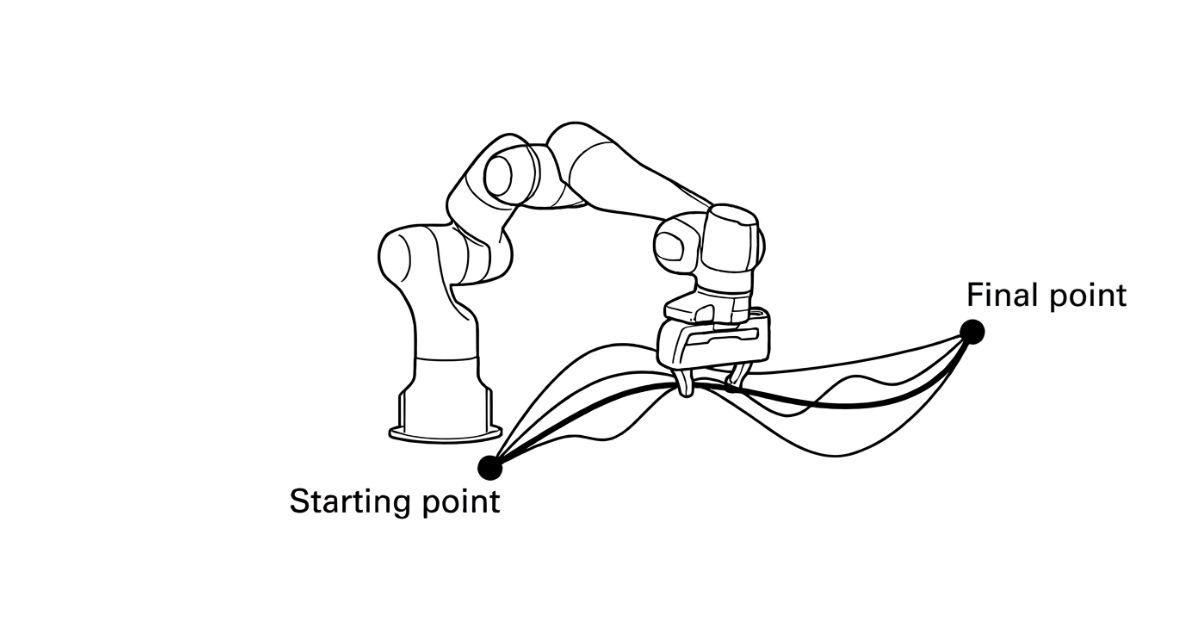
Learning from Demonstration empowers novice users to teach robots daily life tasks without writing sophisticated code, thereby promoting the democratization of robotics. However, novice users often provide sub-optimal demonstrations, which can potentially impact the robot’s ability to efficiently learn and execute the tasks. Prior research has assessed the quality of demonstrations by evaluating the robot’s task performance; however, the approach remains insufficient to qualify individual demonstrations, leaving the reason for classifying demonstrations as high- or low-quality unknown. Therefore, this simulation-based study aims to quantify the quality of individual demonstration at each step by incorporating motion-related quality features such as manipulability and joint-space jerk.
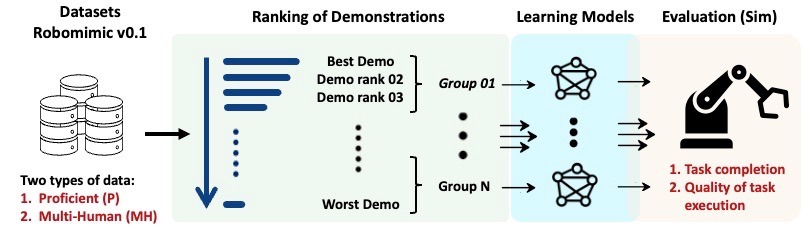
Our results illustrate a strong correlation between ranked demonstrations and the quality of task execution. Interestingly, we observed that the quality features have a significant impact on task performance, particularly when the provided demonstrations exhibit diversity in terms of quality. Overall, this analysis enables quantifying the quality of individual demonstrations based on motion-related quality features, thus improving learning from demonstration.
Key Findings
This study makes three primary contributions:
- Utilisation of motion-based features to quantify the quality of individual demonstrations before learning process.
- Transferability of quality features from provided demonstrations to the corresponding LfD model generated motions.
- Quality features can serve as an indicator of task performance when used in a diverse set of demonstrations.
Resources
Citation
Muhammad Bilal, Nir Lipovetzky, Denny Oetomo, and Wafa Johal. Beyond Success: Quantifying Demonstration Quality in Learning from Demonstration. In Proceedings of the IEEE/RSJ International Conference on Intelligent Robots and Systems (IROS), pp. 5120–5127, 2024. DOI:10.1109/IROS58592.2024.10802187