
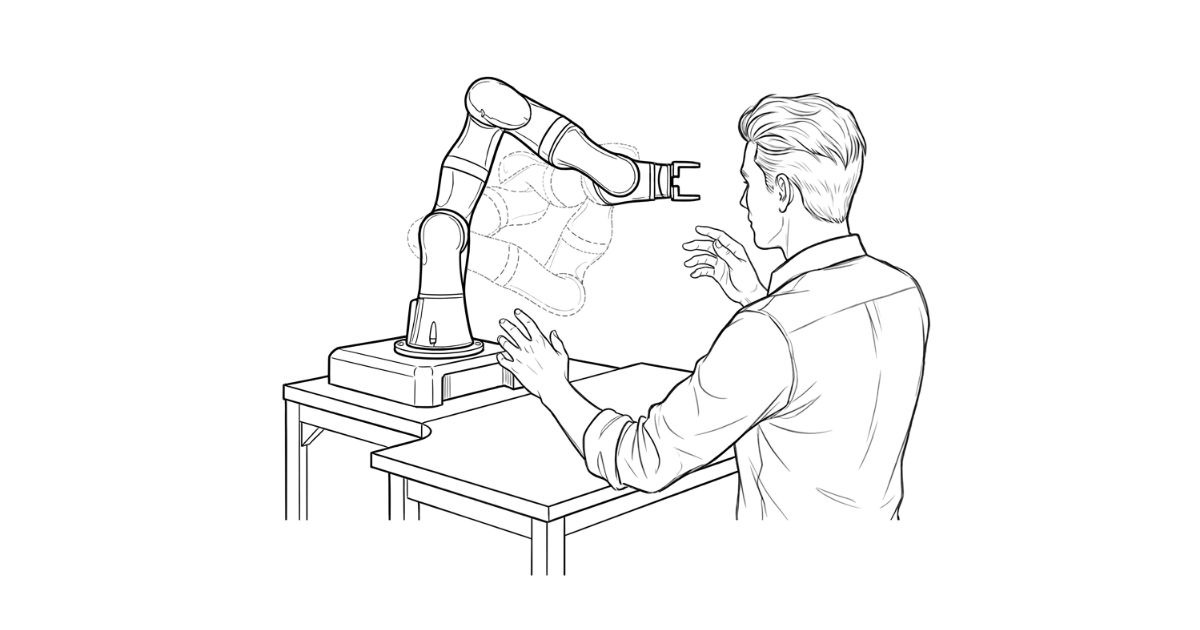
Kinematic redundancy, where a robot has more joint degrees of freedom than required for a given task, provides greater flexibility during kinesthetic demonstrations. However, this flexibility also introduces additional complexity, as novice users must navigate a larger set of feasible robot configurations. This project investigates how the robot’s degree of redundancy (DoR) affects human performance during kinesthetic demonstrations and, in turn, how the resulting demonstrations influence robot learning and task execution.
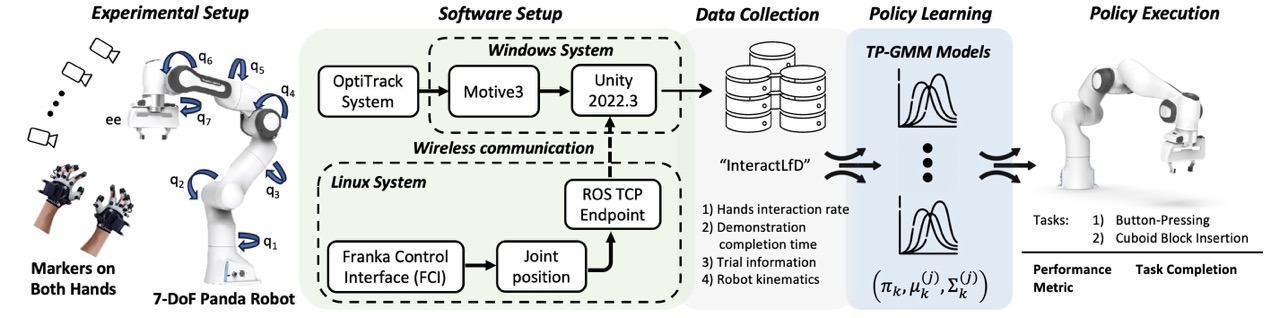
To study the impact of robot redundancy, we artificially reduced the robot’s DoR by locking one of its joints. We then conducted a within-subject user study with 24 participants, comparing two conditions: high DoR (unconstrained) and low DoR (constrained). Our experimental setup also incorporated a motion capture system to record participants’ hand interactions with individual robot joints, enabling detailed joint-level analysis of physical interaction during teaching.
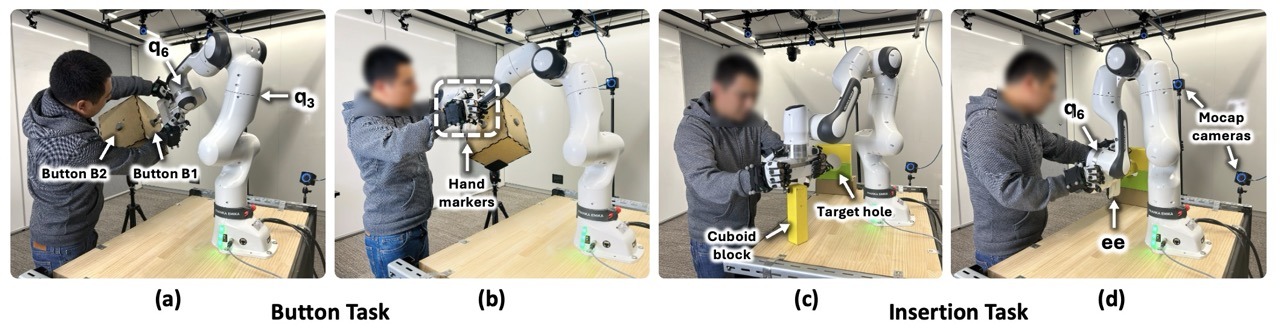
Participants completed two manipulation tasks: button pressing and cuboid block insertion.
User Experiment Videos
This participant first performed button pressing task under constrained condition followed by unconstrained condition.
This participant first performed insertion task under unconstrained condition followed by constrained condition.
Key Findings
- Constraining the robot’s redundancy significantly increased participants’ mental workload.
- Demonstrations took longer to complete under the low-DoR condition.
- Reduced redundancy resulted in more failed demonstration attempts.
- Participants physically interacted with the robot’s joints more frequently when redundancy was reduced.
- Demonstrations collected under the low-DoR condition led to poorer subsequent robot learning and task execution.
To support reproducibility and future research, we also released InteractLfD, a comprehensive dataset of human kinesthetic demonstrations collected during this study.
Resources
Citation
Muhammad Bilal, D. Antony Chacon, Nir Lipovetzky, Denny Oetomo, and Wafa Johal. Investigating the Impact of Robot Degree of Redundancy on Learning from Demonstration. In Proceedings of the 21st ACM/IEEE International Conference on Human-Robot Interaction (HRI), pp. 825–833, 2026. DOI:10.1145/3757279.3785606